Hydraulic Flow Divider: What Is It?
Introduction – Purpose of Flow Dividers
Hydraulic systems may use tee connections to split a pump’s output into multiple lines; however, if branch resistances are not equal, the flow in each line differs. A valve called a flow divider splits incoming flow into two or more paths equally or in defined ratios and compensates for pressure fluctuations in the circuit, ensuring that system components operate in synchrony . Flow dividers are used in many applications, such as cylinder synchronization, simultaneous rotation of hydraulic motors, or sending a fixed portion of one line to another circuit.
Spool‑Type Hydraulic Flow Dividers
Spool‑type flow dividers consist of a movable spool and two fixed orifices inside a housing. Oil enters the valve and is divided through the orifices to both outlets. The pressure difference between the outlets exerts a force on the spool, moving it to adjust the orifice opening for the line that needs more flow; thus, pressure compensation yields nearly equal flows .
Features of Spool‑Type Dividers
-
Unidirectional flow: Spool‑type dividers allow flow only in one direction; in reverse flow, one outlet can be completely blocked. Therefore, return flow must bypass the divider via check valves when synchronizing cylinders .
-
Equal or proportional splitting: Orifice sizes allow 50/50, 60/40 and other ratios; the most accurate results are obtained at the nominal flow rate of the valve . When flow drops below nominal, balancing accuracy decreases; above nominal, high pressure drop causes heating and inefficiency .
-
±5 % accuracy: Spool‑type dividers typically provide ±5 % variation between outlets; the inlet pressure always equals the highest outlet pressure . When one circuit operates at low pressure, the other circuit’s energy is lost as heat; if outlet pressures differ by more than 300–500 psi (20–35 bar), a motor‑type divider is preferred .
-
Limitations with multiple outputs: For more than two outlets, several spool‑type dividers must be connected in series, and the total number of dividers must be odd to maintain equality .
Spool‑Type Divider Diagram
The following diagram illustrates the working principle of a basic spool‑type flow divider. Oil enters the valve; the spool and orifices split the flow into two outlets. The spool moves in response to pressure differences to balance the flows.
Gear (Motor‑Type) Flow Dividers
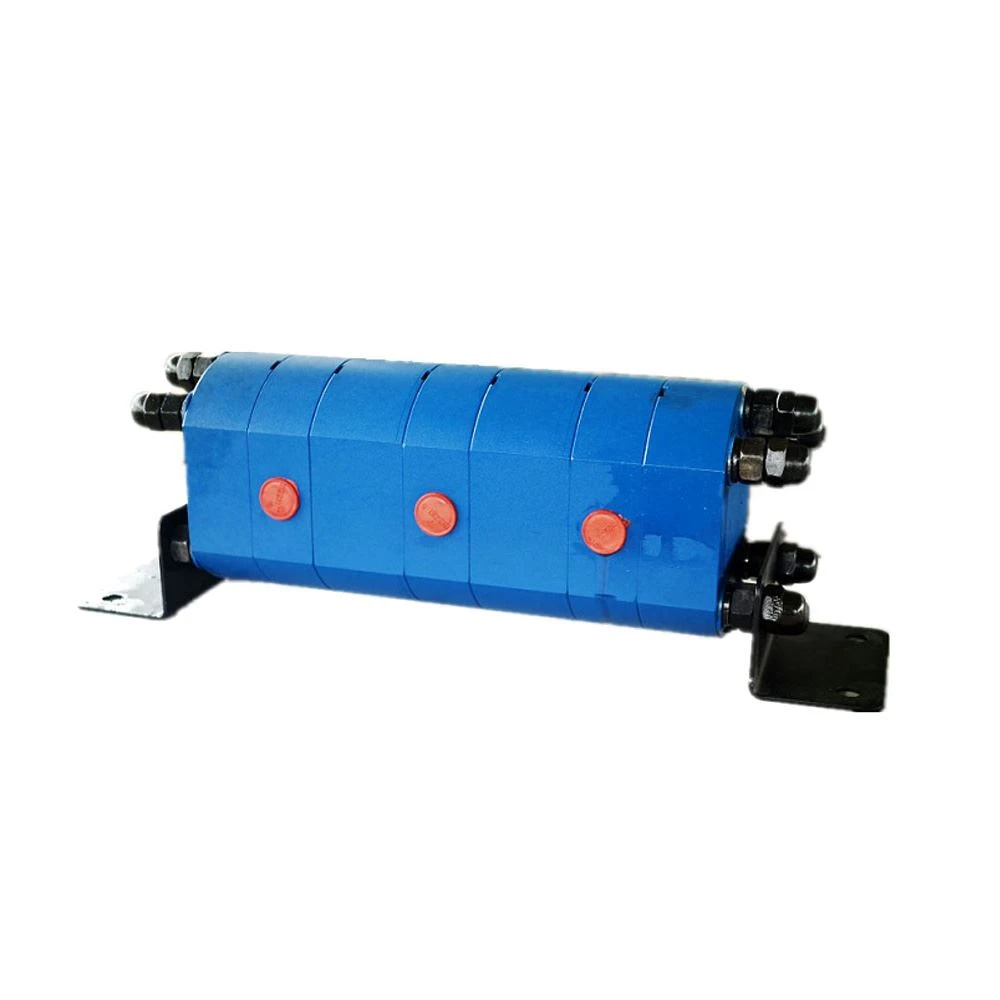
Gear‑type or motor‑type flow dividers consist of multiple gear pump elements mechanically connected on a common shaft. Each gear element, like a gear pump, produces a constant volumetric flow, and each revolution of the shaft sends the same volume of fluid to all sections . This provides precise synchronization between outlets.
Features of Gear‑Type Dividers
-
Positive displacement operation: The geometric volume of each gear section is fixed; each revolution delivers equal volume to all outlets .
-
Bidirectional operation: Gear‑type dividers rotate in either direction, so they can divide or combine flow; this allows synchronized return of cylinders in reverse .
-
High efficiency and accuracy: When properly designed, gear‑type dividers are efficient and accurate; division error is about 3 %, and accuracy is maintained provided the pressure difference between sections does not exceed 30 bar . For larger differences, outlets at lower pressure should be preloaded using pre‑charge valves .
-
Long service life: With equal‑length pipelines, appropriate viscosity and cleanliness, gear dividers operate reliably for extended periods .
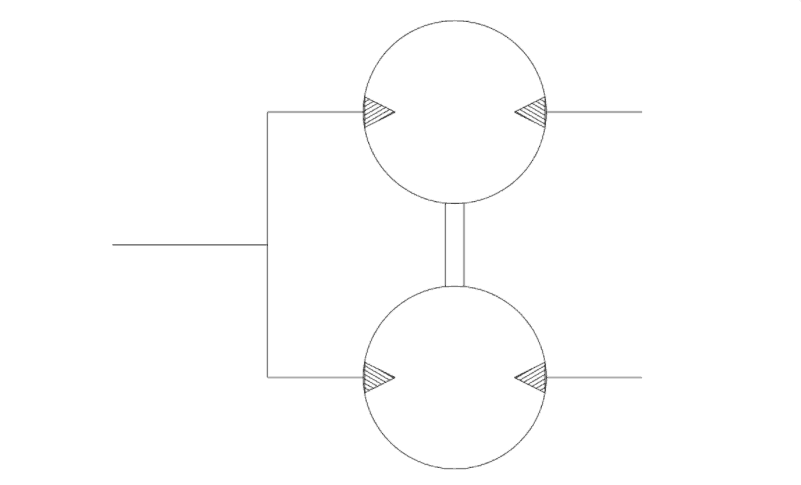
Gear‑Type Divider Diagram
The diagram below shows how a flow divider with two gear modules works. Gears rotating on a common shaft draw oil from the inlet and deliver equal volumes to both outlets.
Comparison of Spool and Gear Types
|
Criterion
|
Spool (Spool) Type
|
Gear (Motor) Type
|
|---|
|
Working Principle
|
A movable spool and orifices balance pressure and split flow into two outlets .
|
Two or more gear pumps on a common shaft deliver a fixed volume per revolution .
|
|
Flow Direction Control
|
Unidirectional; requires check valves for synchronized return .
|
Bidirectional; divides or combines flow .
|
|
Flow Accuracy
|
±5 % accuracy; should operate near nominal flow .
|
~3 % error; high accuracy at pressure differences below 30 bar .
|
|
Energy Efficiency
|
Poor efficiency when outlet pressures differ widely; energy is lost as heat .
|
More efficient; lower mechanical losses due to gear mechanism.
|
|
Cost and Complexity
|
Simple and economical; multiple units needed for more outlets .
|
More complex and costly; requires precise machining and installation. |
Applications and Use Cases
-
Cylinder synchronization: Spool or gear‑type dividers ensure multiple hydraulic cylinders extend and retract at the same speed in presses and lifting platforms.
-
Mobile equipment: Gear‑type dividers synchronize two motors rotating at the same speed in excavator booms, loader arms, or agricultural machinery.
-
Priority circuits: Spool‑type priority flow divider valves provide constant flow to critical circuits like steering or brake systems .
Conclusion
Hydraulic flow dividers are vital control elements designed to split a single pump output into multiple lines equally or in desired ratios. Spool‑type dividers provide proportional flow division through pressure compensation and require additional valves for reverse flow; they stand out for their low cost and compactness. Gear‑type dividers use positive‑displacement gear elements to deliver equal volumes of oil per revolution, splitting or combining flow accurately in both directions . When outlet pressure differences are high or bidirectional synchronization is needed, gear‑type dividers are the better choice; spool‑type dividers offer an economical solution where flow and pressure requirements are moderate.
Selecting a flow divider requires careful consideration of system flow and pressure demands, synchronization accuracy, and energy efficiency to ensure a long‑lasting and reliable hydraulic circuit.




 Türkçe
 English